)
Apr 1, 2026
Understanding repurposed energy storage systems
Read post
)
Electricity demand in the United States is accelerating at an unprecedented rate. Driven by the rapid growth in AI and cloud computing, data centers alone could consume 12% of U.S. electricity by 2028, tripling their load compared to 2023. At the same time, the electrification of transportation, residential heating and cooling, and industrial processes is adding tens of gigawatts of new electrical load annually.
This surge is straining traditional power infrastructure. Across U.S. power markets, average interconnection timelines exceed 2-4 years, with full transmission upgrades often taking 7-10 years. For AI infrastructure operators, these delays are costly, as planned facilities remain unbuilt while demand continues to grow.
Battery Energy Storage Systems (BESS) have become a critical component in meeting these growing power demands, enabling flexibility, reliability, and renewable integration at grid-scale. However, long lead times, cost volatility, and reliance on global supply chains have increased risk, elevating the need for domestically sourced energy infrastructure that can scale without compromising speed or cost. What's needed is a fundamentally different approach to energy storage: one built on domestic supply, rapid deployment, and proven technology.
Redwood Materials is addressing the surge in energy demand through Redwood Energy. Rather than relying on traditional containerized BESS built solely from new, uniform, and typically imported, cells, Redwood Energy repurposes the growing domestic supply of EV battery packs, both new and those retired from vehicle use. Many retired EV packs retain substantial usable capacity (often more than 80%) making them well-suited for stationary storage applications with less power-intensive duty cycles than transportation.
Integrating these packs into storage in their original form factor has several benefits:
Lower cost - Redwood Energy delivers utility-scale storage at up to 50% lower total installed cost than legacy systems through strategic domestic battery sourcing, an optimized blend of repurposed and new EV packs, and simplified system design that reduces both hardware and installation costs.
Available domestically - Redwood’s BESS also avoid import duties and are Investment Tax Credit (ITC)-eligible and FEOC-compliant, creating an even more competitive cost structure.
Faster - With multi-GWh of ready-to-deploy inventory available today, we can accelerate speed to power with storage that can typically be deployed within 6-12 months.
This is not a future concept, but a solution built to meet current demand and supply chain complexity. And the opportunity is massive: by 2030, end-of-life batteries could supply more than 50% of the entire energy storage market.
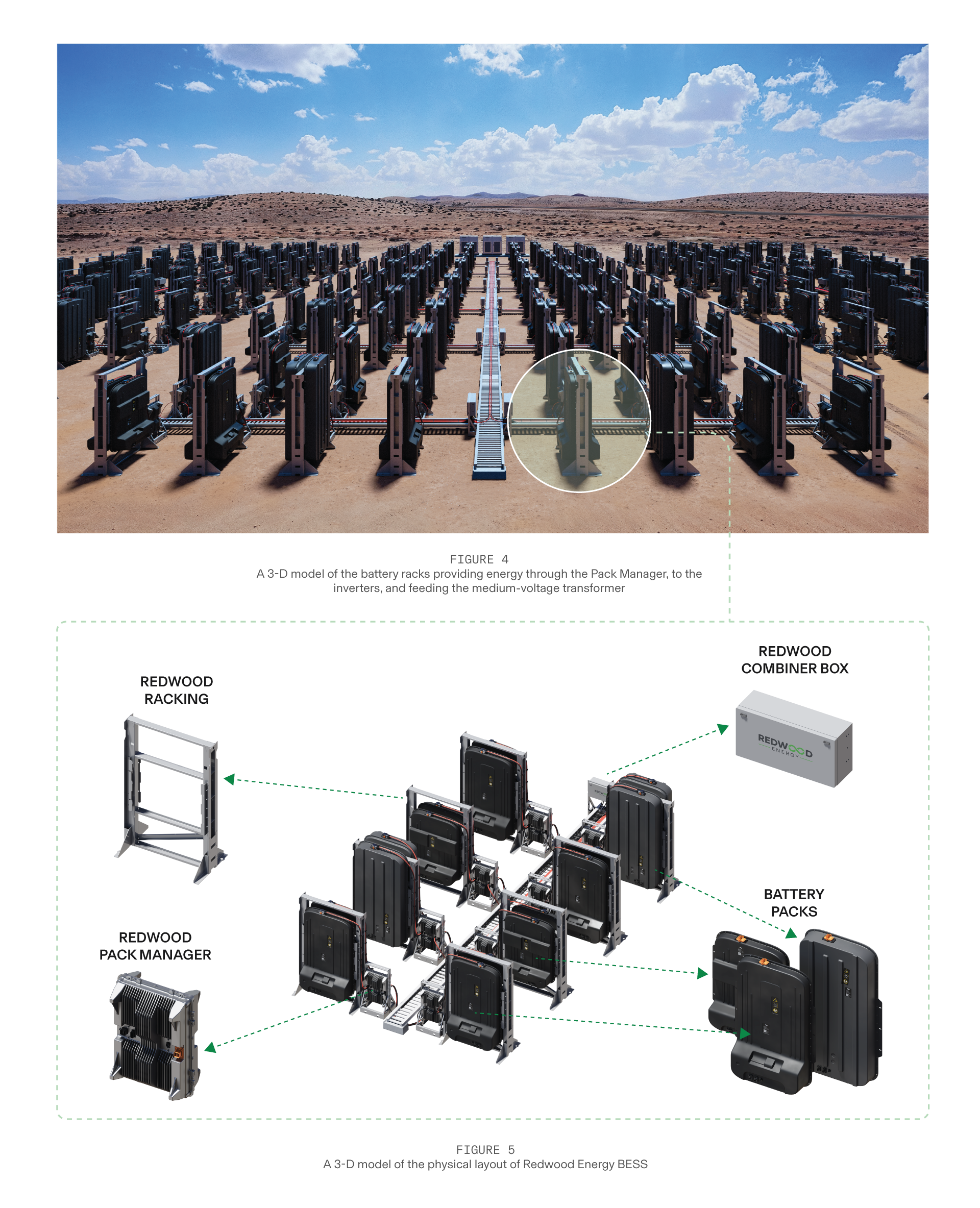
At the core of the Redwood BESS is the Pack Manager, a universal interface that sits between each EV battery pack and the rest of the energy storage system. Electrically, it conditions and regulates voltage and current at the pack level, enabling batteries with different chemistries, voltages, and designs to safely and efficiently coexist within a single system.
The Pack Manager enforces pack-level operating limits, intelligently derating weaker or more degraded batteries while allowing healthier packs to carry a greater share of the load. This architecture enables the fleet to be expanded or refreshed over time without redesigning the system, delivering reliable power and energy even as individual packs age. Redwood Energy's BESS design and warranty also account for the variable nature of repurposed batteries with a baseline of 10 years extendable up to 25 years along with full long-term service agreements.
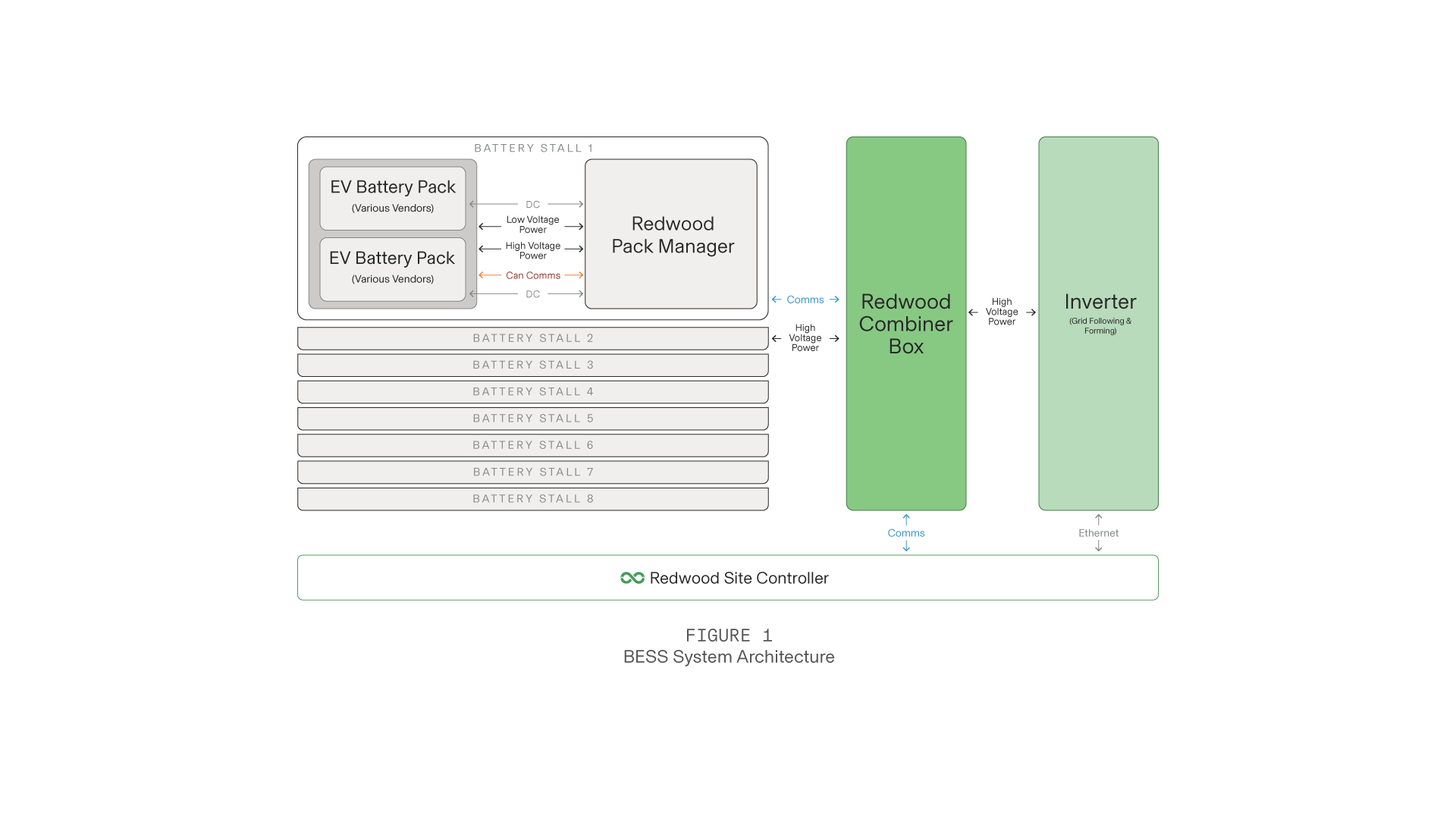 Fleet Orchestration
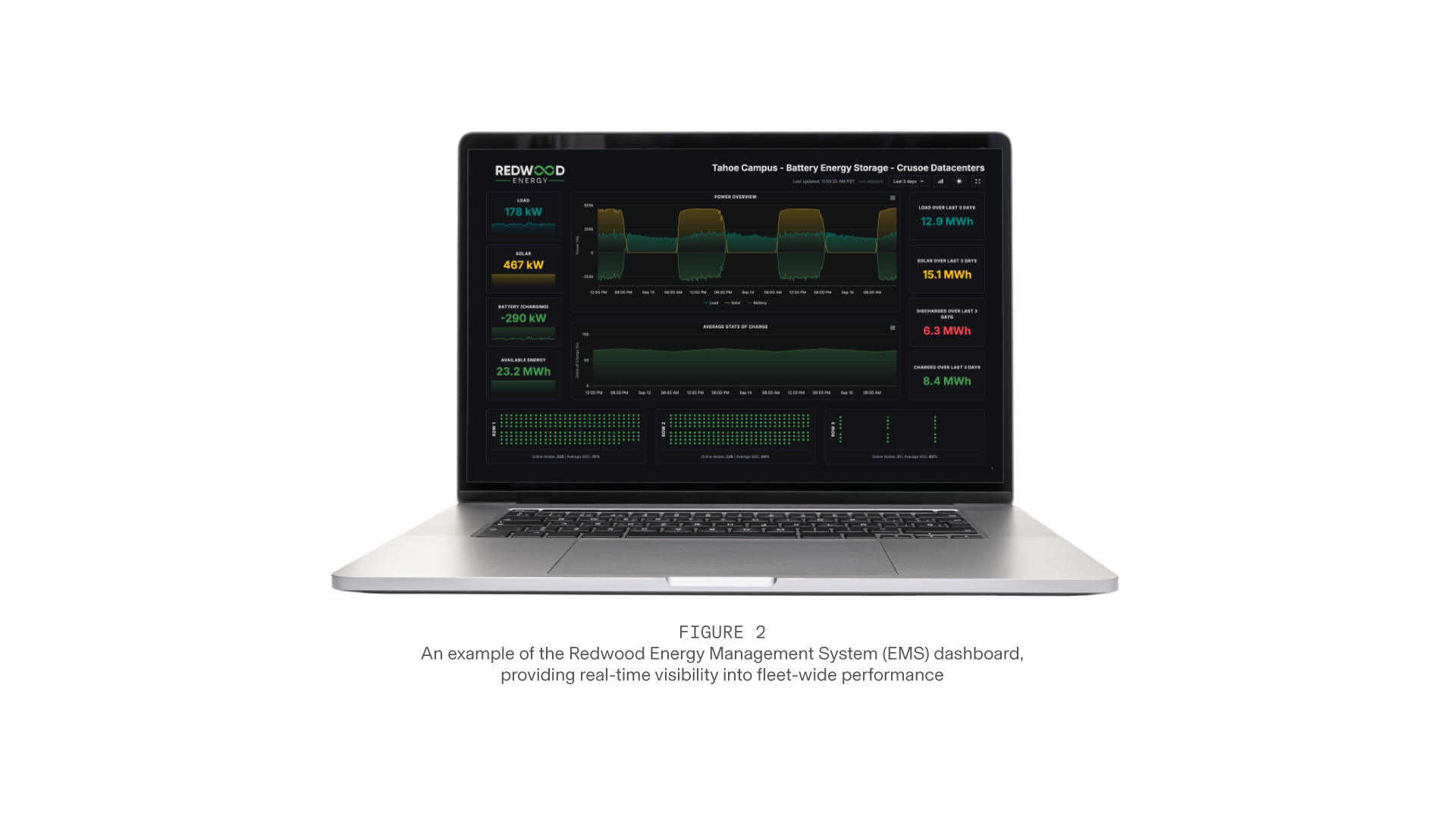
 A site controller orchestrates the entire BESS, collecting thousands of diverse EV battery packs into a single, unified energy asset. The site controller aggregates real-time data from every pack in the system, including state of charge (SOC), state of health (SOH), and other key metrics. Redundant architecture ensures that individual component failures do not interrupt power delivery, allowing the system to continue operating through faults or maintenance events and delivering the uptime and availability required for mission-critical applications.
For data centers seeking to reduce demand charges, the system can precisely shave peak loads.
For AI compute facilities requiring fixed-capacity delivery, the controller reliably maintains contracted power levels by managing the fleet's aggregate state of charge and automatically routing around degraded packs.
For renewable energy projects, it smooths intermittent solar or wind generation by intelligently charging during production peaks and discharging during generation gaps, transforming variable resources into dependable power.
The selection and qualification of repurposed EV battery packs require detailed tracking of each pack’s origin, diagnostic data, and physical condition, along with validation of electrical, thermal, and mechanical performance. Redwood Materials has developed a structured qualification framework, the Redwood Battery Asset Tracking System, that combines digital traceability, standardized inspection, and automated screening to ensure all battery assets deployed within the Redwood Energy BESS meet stringent safety and performance criteria. Redwood’s qualification operations process hundreds of battery packs per day using standardized digital workflows, and Redwood continues to work with industry stakeholders to advance best practices.
Incoming battery packs are organized into controlled inventory lots to support physical organization and traceability. Material attributes such as packaging configuration, supplier lot information, and incoming condition are recorded as part of Redwood’s digital asset tracking workflow.
Prior to screening, battery packs undergo visual inspection to verify enclosure integrity and identify damage or abnormal conditions. Battery packs that pass visual inspection proceed to Redwood’s electrical screening process where screening results are captured digitally and used to support battery qualification decisions.
Packs that meet defined acceptance criteria are approved for deployment and tracked through controlled storage and handling processes that maintain traceability through system integration.
By tracking each pack through the Redwood Battery Asset Tracking System, this allows Redwood Energy to offer a guaranteed Capacity Maintenance Agreement (CMA) at a fixed annual cost per contracted kWh.
Over time, as the batteries naturally degrade, individual packs are proactively replaced to maintain contracted capacity. Unlike traditional augmentation plans, this approach preserves the original physical layout of the system, eliminating the need for redesigns or site expansion. For the customer, this means guaranteed capacity, which mitigates degradation risk.
Redwood Energy’s BESS is designed with safety, long-term durability, and mechanical simplicity as foundational principles. Pack spacing and open-air layouts inherently prevent propagation of fires and eliminate the need for complex mitigation systems. The automotive-grade batteries operate at only a fraction of their original design power in stationary storage applications, minimizing thermal stress and extending service life.
This contrasts with conventional energy storage systems, which are often operated near rated power, requiring extensive active thermal management. These traditional containerized solutions can be over-reliant on active mitigation systems, such as HVAC and coolant systems, and sometimes even complex deflagration vents or sparker systems, whereas Redwood’s offering eliminates the need for any of these systems through an inherently safer passive safety architecture. Each battery stall is electrically isolated, and the DC architecture ensures that a single pack failure does not compromise the broader system. Redwood’s passively safe design reduces ongoing operational costs while improving long-term reliability, which are critical attributes for data centers and industrial facilities that cannot tolerate extended outages.
UL 9540, the product safety standard for energy storage systems, requires each major subsystem to carry its own component-level listing. For battery systems, the applicable standard is UL 1973, written for newly manufactured packs in which the producer controls cell selection, module assembly, and pack integration from the ground up. UL 1973 does not yet provide a compliance pathway for repurposed automotive packs. This is a standards gap, not a safety gap.
Redwood Energy systems have completed large-scale fire testing to the current 6th Edition of UL 9540A, the most demanding fire safety protocol in the BESS industry, subjecting the system to worst-case thermal runaway propagation and measuring heat release, gas generation, and deflagration potential under real-world conditions. The system passed every applicable test. In terms of other parts of the system, the Pack Manager is designed to be listed for UL 1741 and will hold UL 1973 recognition as a battery management system, or BMS. The Combiner Box will be listed to UL 1741, and all upstream power conversion and interconnection equipment are also designed to be listed to applicable standards.
Our systems undergo the most rigorous safety evaluations available for this class of product, and they’re a reflection of Redwood's broader commitment to setting the standard, not just meeting it. Redwood’s staff chair task groups under the UL 9540, UL 1974, and NFPA 800 Technical Committees that are developing revisions that will establish a formal compliance pathway for repurposed BESS systems in the future.
Redwood Energy's approach carries a unique sustainability advantage. By using repurposed batteries already in circulation, we can reduce the need for new mining, refining, and cell manufacturing, avoiding the emissions embedded in those upstream processes.
A lifecycle analysis (LCA) of a 104 MWh system demonstrates this impact: Redwood Energy systems produce 4-5 kg CO₂e/kWh, compared to 65-100 kg CO₂e/kWh for new, imported LFP (lithium iron phosphate) systems, a 90% reduction in carbon emissions.
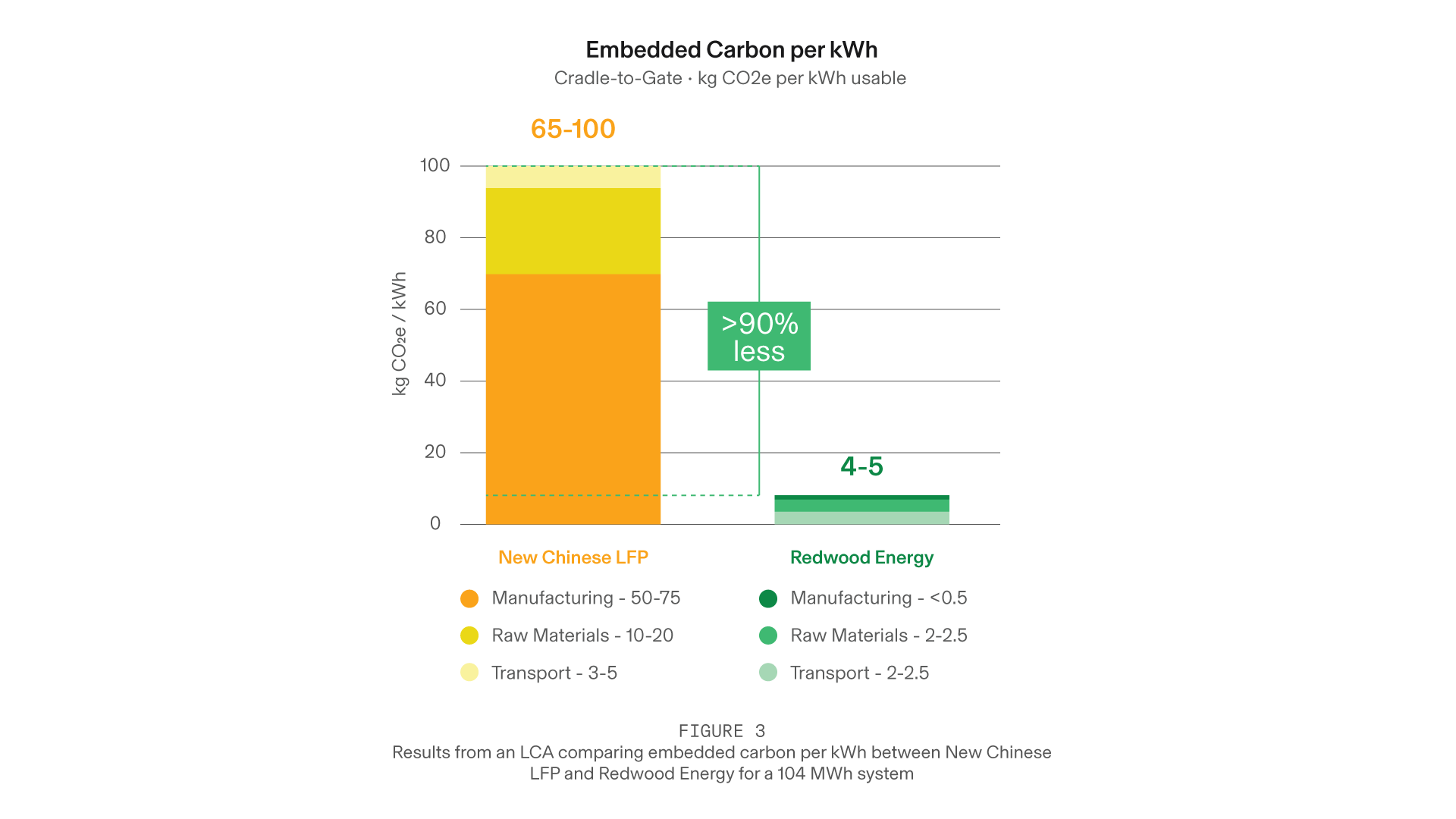
For hyperscalers and other industrial customers, this solution offers not just a faster and cost-effective path to power, but also a cleaner one, which is instrumental in meeting ambitious carbon reduction targets many companies have committed to.
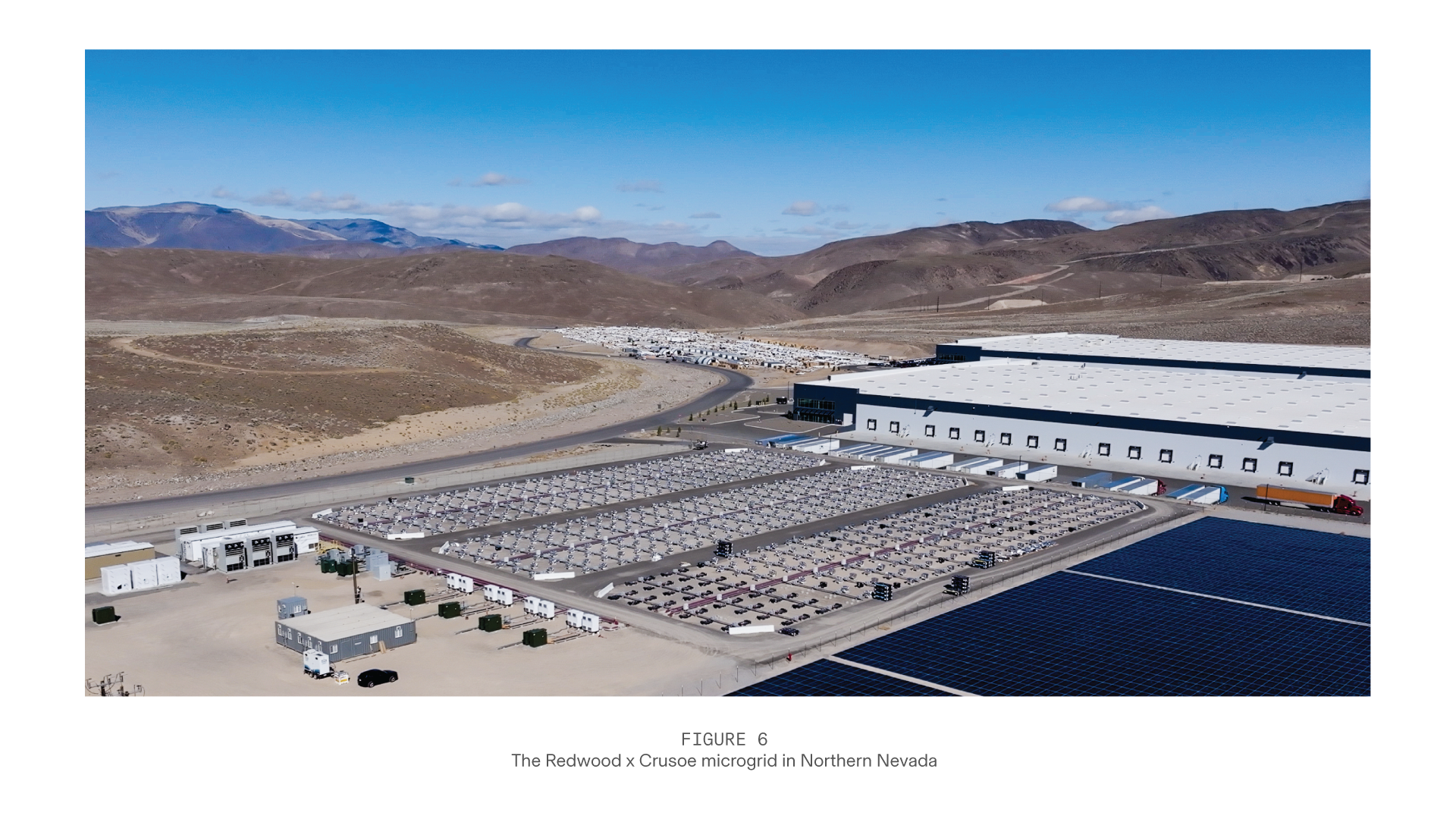
At Redwood's Nevada Campus, a 12 MW solar array charges 63 MWh of repurposed battery storage, which powers 4 modular data centers operated by Crusoe, expanding to 24 modular data centers over the coming months. Redwood designed, built and fully commissioned this microgrid, the largest in North America, in less than four months. Since launch, Redwood Energy’s system has delivered 99.2% operational availability for Crusoe with minimal downtime. This demonstrates how repurposed BESS can rapidly and reliably power data centers and other large-scale loads.
The transition to secure energy infrastructure is no longer a question of if, but of how fast we can scale the underlying infrastructure. By unlocking the value of millions of EV packs already in the United States, Redwood Energy decouples grid growth from the constraints of volatile international supply chains. We aren't just building storage systems; we are architecting a resilient, circular energy future for the U.S., one that grows stronger with every gigawatt-hour deployed.
Learn more about Redwood Energy's solutions at www.redwoodmaterials.com/energy and find detailed specifications here.
Resource Center
Apr 1, 2026
Understanding repurposed energy storage systems
Read post
)
Apr 1, 2026
Data Center Energy Storage: Solving speed to power for AI factories
Read post
)
Jun 27, 2025
Redwood Energy: Fast, low-cost storage to power the age of AI and a changing grid
Read post
)
Apr 1, 2026
How battery energy storage systems (BESS) bridge energy generation and demand
Read post