)
Mar 25, 2026
Redwood's energy storage systems meet (and exceed) new safety benchmark
Read post
)
Electricity demand is surging due to the growth of AI data centers and the rapid electrification of every sector. Meeting this demand will not only require more generation capacity, but also new solutions that can deliver faster and lower-cost energy.
Battery energy storage is essential to this transition; it helps the grid respond to variable demand, improves reliability, and reduces reliance on fossil fuels. However, legacy systems often rely on new, imported batteries, which are too expensive to scale. EV battery packs that are no longer suitable for vehicles but ideal for stationary storage, often referred to as second-life batteries, offer a solution to unlocking affordable energy storage.
Battery Energy Storage Systems (BESS) store electricity and deliver it when needed. They are increasingly used to:
Balance supply and demand during peak load periods
Provide backup power for critical operations
Support the integration of intermittent renewable energy sources like wind and solar
Improve overall grid reliability and flexibility
These systems are also critical for delivering power where grid infrastructure is limited or delayed. With average interconnection timelines exceeding 2–4 years and full transmission upgrades often taking 7–10 years, storage provides a path forward as industries and technologies evolve faster than utilities can expand capacity.
Second-life refers to lithium-ion batteries that have reached the end of their useful life in electric vehicles but still retain substantial usable capacity. While no longer suitable for vehicle use, these batteries are prime for stationary storage applications with less power-intensive duty cycles than transportation.
Repurposing battery packs into energy storage systems offers a number of advantages:
Cost-savings: Repurposing batteries is more affordable than manufacturing or importing new ones. For example, Redwood Energy delivers utility-scale storage at up to 50% lower total installed cost than legacy systems through strategic domestic battery sourcing, an optimized blend of repurposed and new EV packs, and simplified system design that reduces both hardware and installation costs.
Domestic availability: As EV adoption grows, the supply of new and retired battery packs is increasing and represents a growing source of domestic feedstock.
Faster deployment: Tapping into existing batteries that are already here enables developers to move faster without relying on volatile, foreign supply chains. Plus, repurposing batteries in their original form factor can speed up project timelines, with typical deployment in months compared to years-long grid interconnection waits.
Resource efficiency: Extending battery life before recycling reduces waste and makes better use of embedded materials and energy, supporting a circular economy.
Today, Redwood receives over 20 GWh of batteries annually—the equivalent of 250,000 EVs—representing the majority of all lithium-ion batteries recycled and processed in North America. Many retain significant usable capacity, enough to be repurposed before recycling. With multi-GWhs of inventory today, this isn't a futuristic projection, but rather a real-world solution meeting today's needs and supply chain complexities.
At the core of Redwood's BESS is the Pack Manager, a universal interface that sits between every EV battery pack and the rest of the energy storage solution. It conditions and regulates voltage and current for each pack so that different chemistries and designs can coexist on the same system. The Pack Manager translates the native language of each pack's Battery Management System (BMS) to allow for optimized system performance, while enforcing pack-level limits so that weaker or more degraded batteries can be gently derated while healthier packs shoulder more of the operational load.
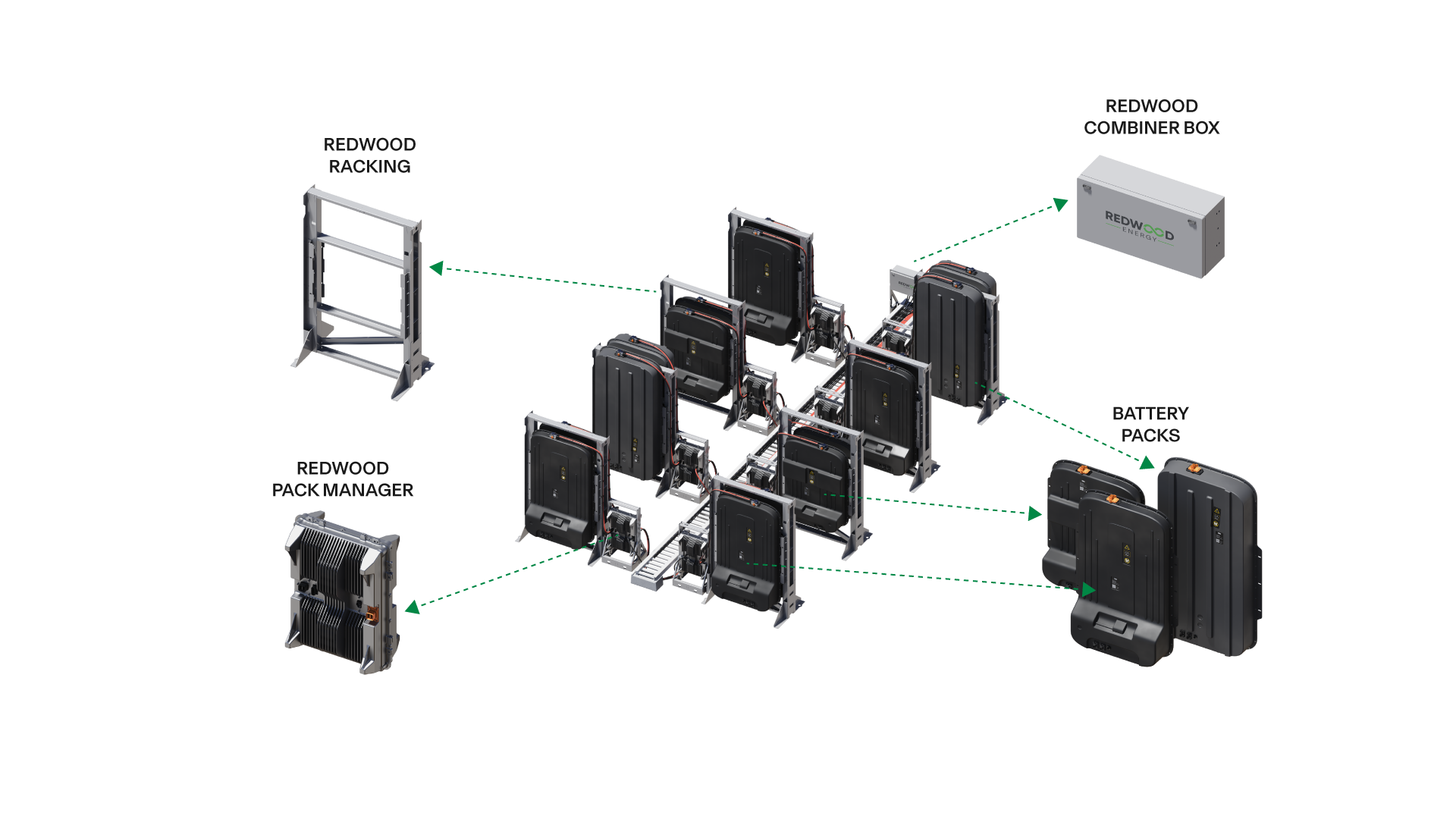 A site controller orchestrates the entire BESS, treating thousands of diverse EV battery packs as a single energy asset. The fleet can be expanded or refreshed over time without redesigning the system, supplying reliable power and energy even as individual packs age and are replaced.
In 2025, Redwood built and fully commissioned a 12 MW / 63 MWh microgrid in Nevada—the largest in North America—in less than four months. Today, it powers Crusoe's AI factory data centers with >99% uptime, demonstrating how repurposed batteries can deliver cost-effective, rapidly deployable storage at scale.
By unlocking the value in millions of EV battery packs already in the U.S., second-life energy storage represents a scalable path forward for BESS. It reduces costs, helps bring new energy infrastructure online faster, and supports clean energy goals, while decoupling grid growth from the constraints of volatile international supply chains. As demand for electricity continues to accelerate, repurposed batteries will play a key role in building flexible, resilient, and affordable energy systems for data centers and our nation’s grid.
To learn more about Redwood Energy’s solutions, visit our website.
Resource Center
Mar 25, 2026
Redwood's energy storage systems meet (and exceed) new safety benchmark
Read post
)
Apr 1, 2026
Data Center Energy Storage: Solving speed to power for AI factories
Read post
)
Jun 27, 2025
Redwood Energy: Fast, low-cost storage to power the age of AI and a changing grid
Read post
)
Apr 1, 2026
How battery energy storage systems (BESS) bridge energy generation and demand
Read post