Nov 11, 2022
Redwood and Audi launch consumer battery recycling program in dealerships across the US
Read post
America has a huge, untapped stockpile of critical minerals —cobalt, nickel, lithium, and copper—locked inside old electronics and forgotten rechargeable devices. Yet with only ~16% of electronics recycled in the U.S., most of those minerals end up stranded in junk drawers or sent to landfills.
Redwood has spent years trying to solve this by making recycling safer and easier for everyone, and partnering with businesses for nationwide drop-off sites, working with nonprofits like Rotary Club on community events, and offering easy direct-ship options for anyone. Now we’re taking a major step forward.
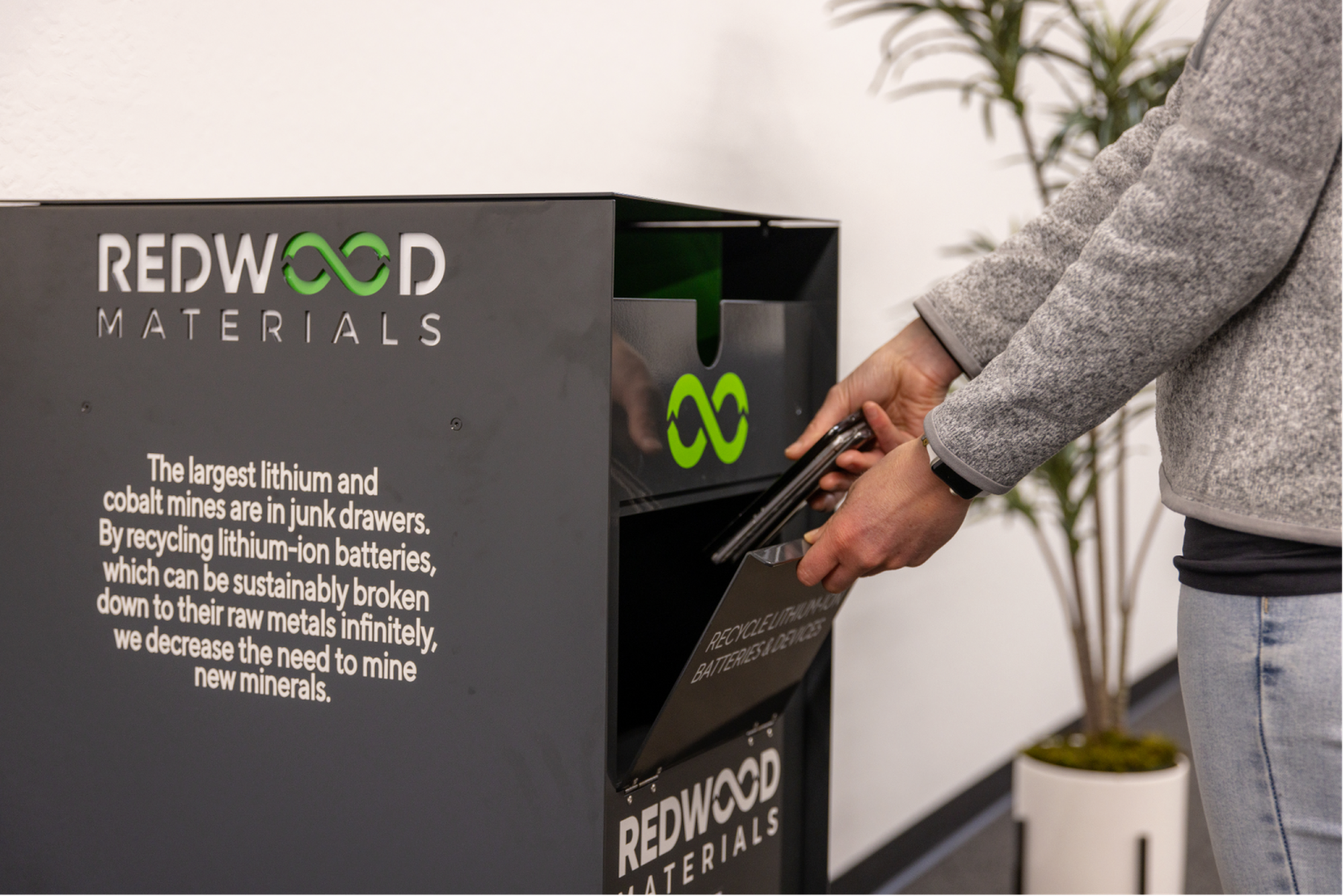
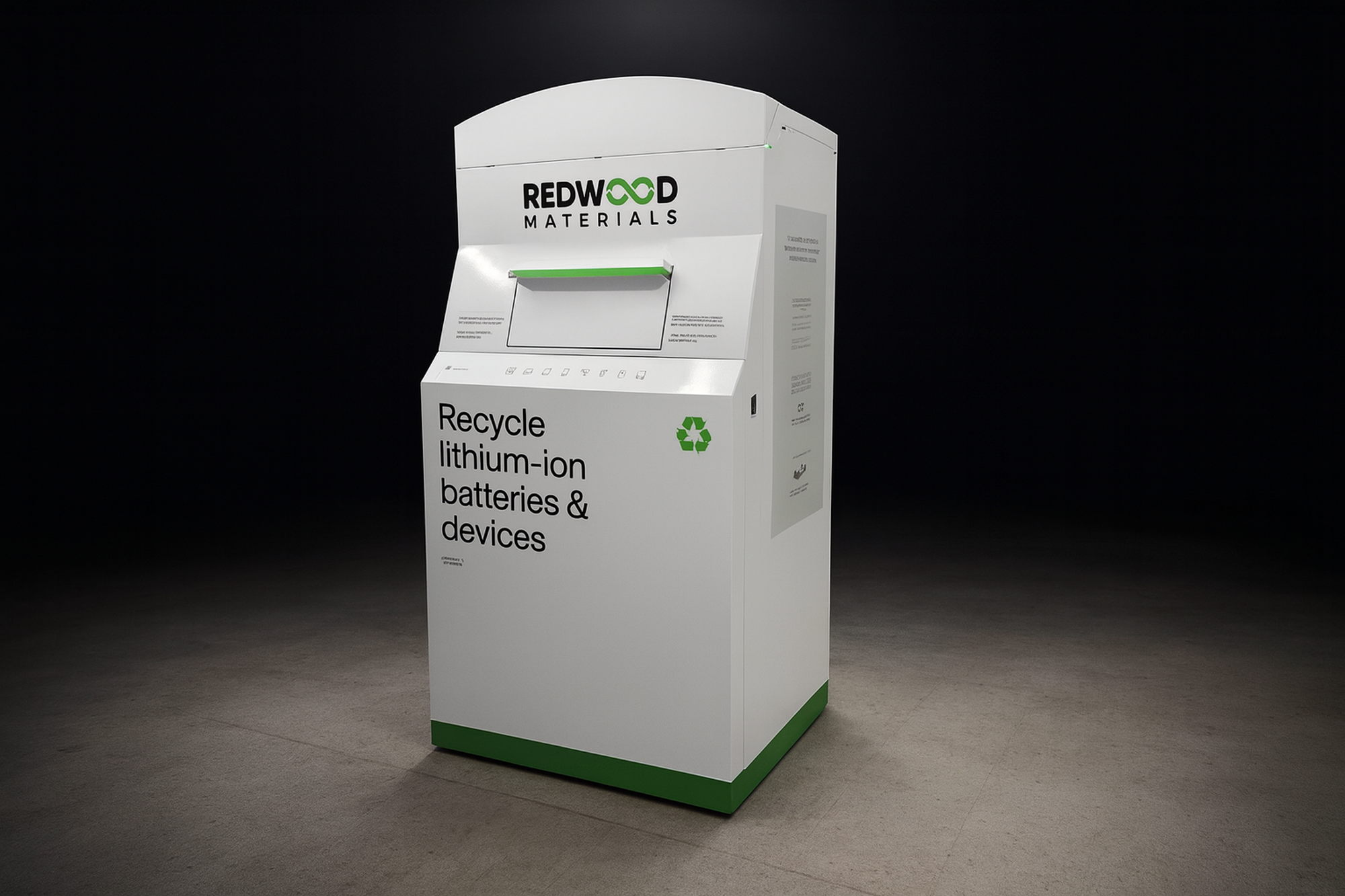
Meet the Redwood Battery Bin: a first-of-its-kind, patented system that safely stores, packages, and monitors hundreds of batteries or battery-containing devices with zero preparation required; no taping, bagging, sorting, or disassembly. Inside, automated sensing, spatial packing, and real-time condition monitoring quietly manage every item, making it the first public-facing collection technology built to handle mixed chemistries and devices at scale with fire-safe storage and continuous telemetry.
First-of-its-kind, patented technology
Battery recycling today still relies on fire-retardant cardboard boxes, often tucked away from public view. They accept limited chemistries, require manual sorting and preparation, and are vulnerable to theft, mishandling, and thermal events.
The Redwood Battery Bin was built to solve those real-world problems. We researched, designed, and commercialized it to make public collection truly safe, simple, and scalable. It’s a patent-approved, first-of-its-kind collection system that accepts mixed batteries and devices, is fully compliant, remotely monitored, and designed with fire safety at the core.
As an independent collector, Redwood recycles the rechargeable batteries we receive and sends anything else to appropriate recycling partners. The bin was built with that same mindset: modern, safe, and easy to use, removing the friction that has kept battery collection rates low for years. And since rechargeable batteries carry both value and real fire risk, getting them out of junk drawers and into proper recycling channels matters more than ever.
San Francisco's regulators, known for having some of the toughest safety and environmental standards in the country, welcomed Redwood’s Battery Bin as a gold-standard approach for public collection.
How it works:
Mixed-battery collection: Consumers can drop off batteries or devices (up to 300 Wh) as-is ( no taping, bagging, pre-sorting, or disassembly required.) Inside, a microcontroller uses infrared, ultrasonic, and positional sensing to evaluate each item, optimizing packing density, and maintaining safe internal conditions.
Automated sensing: From the outside the bin looks simple, but inside it’s a fully-automated sensing and materials-management platform that continuously verifies internal status and monitors deposited items without manual intervention.
Real-time telemetry: The bin communicates its condition in real time, giving operators full visibility into drum position, fill level, volume, and system health, dramatically reducing site-level labor and touch points that challenge traditional recycling programs.
End-to-end service: Collected materials are then securely transported and processed at Redwood’s facilities in Nevada & South Carolina, where we recover more than 95% of the critical materials in batteries.
Together, these features create a safer, more reliable, and truly scalable collection system. By combining automated sensing, real-time telemetry, fire-suppression media, and secure containment in a single unit, the bin reduces the labor, sorting, and monitoring burdens that limit most public drop-off programs. It also addresses key risks—preventing theft and data exposure, minimizing thermal-event hazards, and ensuring consistent compliance.
Designed for standard retail and municipal logistics, the bin ships easily, lowers handling costs, and makes high-volume battery collection practical in busy public settings. And with a visible, user-friendly design, it enables communities to collect significantly more material while keeping people and facilities safer.
How to recycle & get involved
We’re launching these bins first across the San Francisco Bay Area and Northern Nevada, establishing a safe and scalable network nationwide for recovering lithium-ion batteries and their critical materials.
In San Francisco, visit any Cole Hardware or Sports Basement to recycle. In Northern Nevada, keep an eye out for new locations coming online soon. You may also visit our website to learn more about how to recycle with us. Every bin is ADA-compliant, bilingual, locked when idle, and opens only via an infrared sensor for secure use. Once unlocked, batteries can be deposited through the chute.
Accepted items: Phones, laptops, tablets, cordless power tool batteries, electric toothbrushes, wireless headphones/speakers, virtual assistant devices, key fob batteries, rechargeable vacuum batteries, and most other lithium-ion and rechargeable devices.
Redwood also partners with retailers, municipalities, and schools to place Battery Bins in high-traffic, trusted locations. Interested communities or businesses can reach us at recycle@redwoodmaterials.com to bring a Battery Bin to their area.
News
Nov 11, 2022
Redwood and Audi launch consumer battery recycling program in dealerships across the US
Read post

Jul 12, 2022
Redwood Materials and Volkswagen Group of America partnership; Redwood to recycle all batteries from Volkswagen and Audi electric vehicles
Read post

Dec 14, 2022
Redwood chooses Charleston, South Carolina region for new Battery Materials Campus
Read post

Apr 14, 2025
Recycling medium-format batteries to power the future of micromobility
Read post